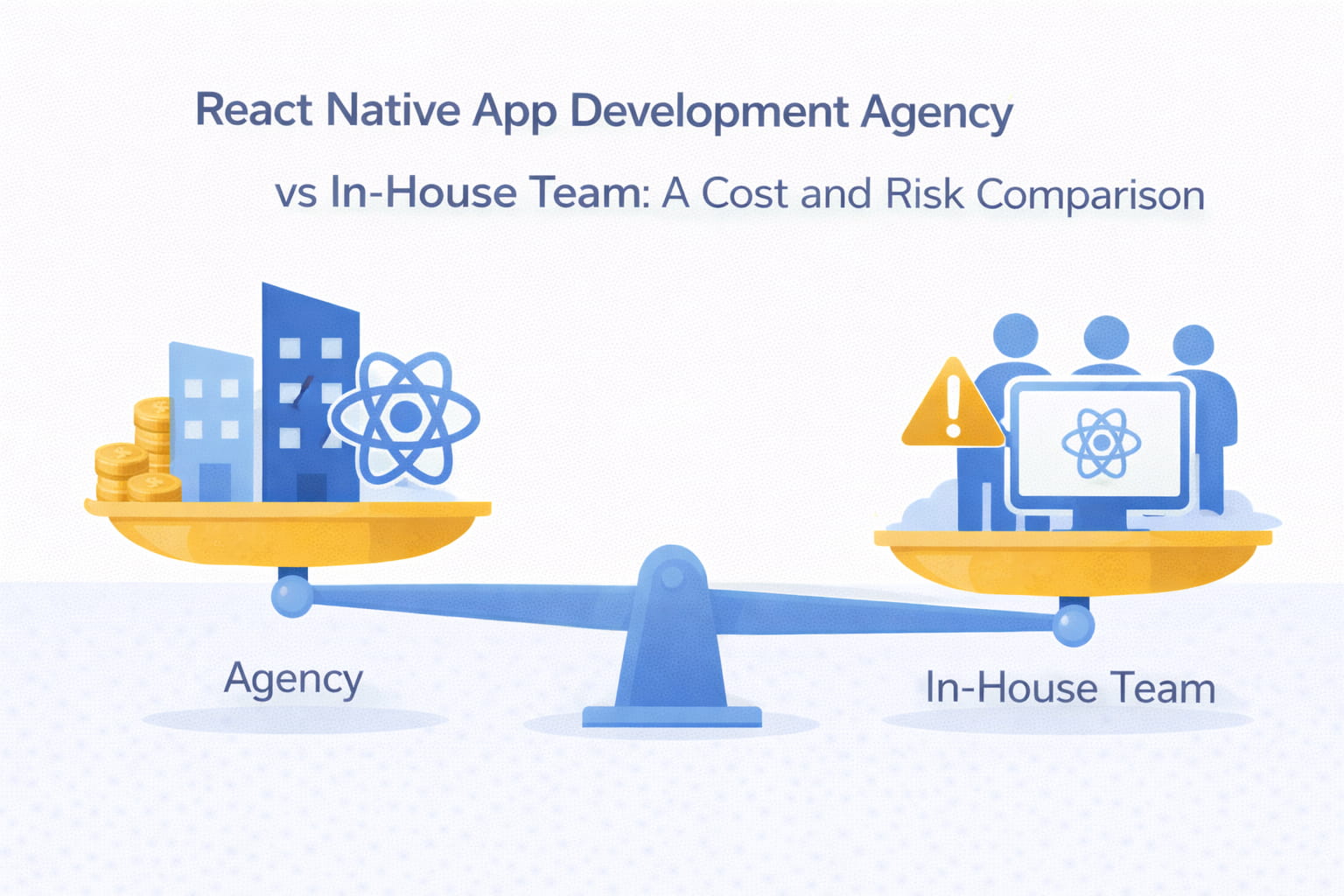
As companies grow, they face a common question: Should we create our mobile app with an in-house team, or should we use a React Native app development agency?
The answer seems simple. In-house teams feel more controlled, while agencies seem faster. One appears cheaper in the long run, and the other seems cheaper at the start. But looking past salaries and hourly rates shows that the real costs and risks are more involved.
This article looks at the actual cost and risk differences between hiring an internal team and using a React Native app development agency, focusing on the business side rather than the technical details.
The Real Cost of an In-House React Native Team
Building an internal mobile team is a long-term investment, which can be true. However, many companies don’t fully understand what in-house means.
It takes time to hire React Native developers. Good engineers are expensive and hard to find. Salaries are just the start. Add recruitment fees, time spent getting them ready to work, benefits, taxes, equipment, and management, and the cost increases quickly. It can take months for a new team to become fully productive.
There’s also the risk of dependency. If key developers leave, progress can slow or stop. Knowledge is held by people, not processes. This can be a serious problem for fast-moving products.
In-house teams are best when mobile development is a key, ongoing part of the business, and the company is ready to support it for a long time.
What You’re Really Paying for in a React Native App Development Agency
A React Native app development agency may seem more expensive at first. Hourly rates are higher than individual salaries. But agencies offer more than just developers.
You’re paying for:
- A team that already works together
- Established ways of doing things
- Project decisions based on past work
- Faster start and quick productivity
- Shared responsibility for results
You’re using an existing system instead of building one from the beginning. This lowers risk for many businesses, mainly when they’re just starting or growing.
Speed Versus Stability: The Real Trade-Off
Companies often choose a React Native app development agency for its speed. Agencies can start quickly, change the number of people working on the project, and release features faster early on
Speed isn’t the only benefit. The main advantage is how predictable they are. With an experienced agency, timelines are clearer, risks are known, and problems are fixed before the product is released.
In-house teams can also be fast once they’re fully staffed and working well together. The challenge is getting to that point without delays, bad hires, or internal problems.
Risk: Who Handles the Pressure?
Every mobile product faces problems, be it changing needs, updates to app store rules or performance issues appear.
With an in-house team, your company handles all the risk. When things go wrong, you fix them internally, often under pressure and without support.
A React Native app development agency shares the risk. They’ve seen similar problems before. They know where React Native projects tend to fail and how to avoid common mistakes. This lowers the chance of expensive errors, mainly those that appear after launch.
Scaling: People Versus Process
Scaling an internal team means hiring more people, which needs more coordination and management. This works but is slow and expensive.
A React Native app development agency scales in a different way. Do you need more developers for a few months? That’s easy. Do you need to slow things down after launch? There are no layoffs or long-term commitments.
This can be a big financial advantage for businesses with varying workloads or uncertain plans.
Knowledge and Long-Term Control
A common worry with agencies is control. What happens when the project is done?
A good React Native app development agency plans for this from the beginning. Clear records, well-organized code, and handover processes ensure your product isn’t tied to the agency.
In-house teams naturally keep knowledge within the company but risk losing it when employees leave. Neither approach is without risk; it depends on how well the risk is managed.
When In-House Teams Are a Better Choice
In some cases, building an internal team makes sense. If mobile development is your core business, you need close connection with internal systems, or you already have good technical leaders.
Internal control often benefits long-term products with set plans. However, many companies still use a React Native app development agency to speed up development or get specialized help.
How Digital Octane Helps
At Digital Octane, we work as a React Native app development agency for companies that want speed and quality.
We often work with startups and growing tech teams that don’t want to spend months hiring or managing mobile experts. Our role is to lower risk, speed up delivery, and create React Native apps ready to grow, not just launch.
In some cases, we add to internal teams. In others, we fully manage mobile development. The key is choosing the approach that best supports business goals.
Conclusion
The choice between an in-house team and a React Native app development agency isn’t about which is best. It’s about which fits your current situation, budget, and how much risk you can handle.
In-house teams offer long-term control but have high starting costs and hiring risks. Agencies offer speed, flexibility, and shared responsibility, which is helpful in early and growth phases. The smartest companies choose based on clear understanding. In many cases, using the right React Native app development agency changes mobile development from a risk into a competitive edge.